


This is the first story in a two part series. To learn more about how the Environmental Management Commission turned away from proposed numeric standards, go to the second story here.
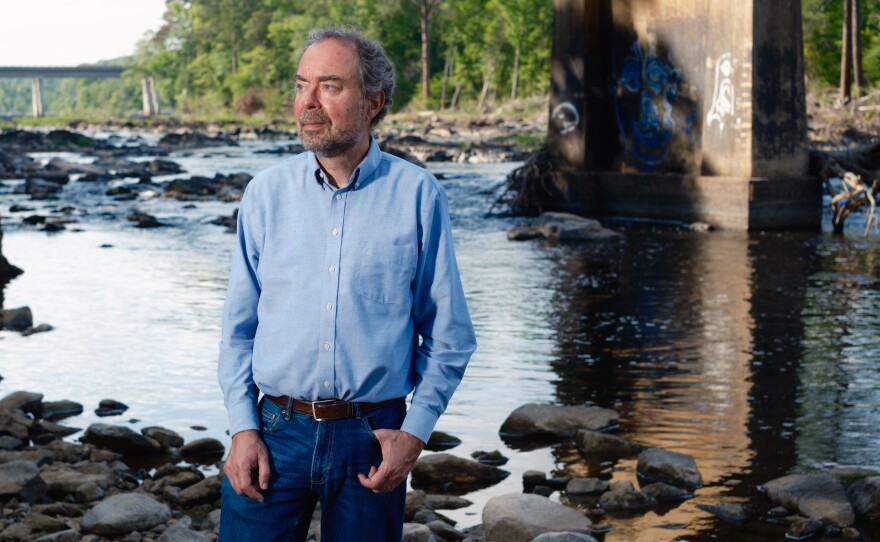
As Detlef Knappe stands on the banks of the Haw River, PFAS and 1,4 Dioxane silently sneak past. These man-made, toxic chemicals can't be seen, tasted or smelled, but they are ubiquitous and ever present.
"PFAS … (are) also known as forever chemicals because they don’t break down in the environment," said Knappe, a renowned PFAS researcher and professor at North Carolina State University. "The Haw River and the Cape Fear (River Basin) have … historically … high (levels) of 1,4 Dioxane and PFAS."
North Carolina's Cape Fear River Basin is the largest river basin in the state. State environmental officials estimate 3.5 million North Carolinians drink tap water with PFAS levels above the EPA standard.

The regulations being considered right now are called the PFAS and 1,4 Dioxane Monitoring and Minimization Plans, respectively. Supporters say they're confident this voluntary approach will result in reductions. Critics say the plans don’t do enough to stop pollution at the source or hold polluters accountable. Public comment is open until June 15.
"(I feel) some combination of disappointment and disgust," said Knappe. "I think the time has come where we know enough about the harms of PFAS that we really should do something to keep (it) out of our drinking water sources."
History and health impacts
It's been almost 10 years now since Knappe helped discover that chemical company Chemours, previously called DuPont, was dumping GenX, a type of PFAS, into the Cape Fear River.
"The most vivid moment was learning that there was not just GenX in the water, (but) that there were many other PFAS in the water about which we knew nothing at all," said Knappe.
PFAS isn't just in the water; it's in everyday products like makeup, clothing, and take-out food containers. Exposure can happen a lot of different ways, including through drinking water that comes from rivers and lakes.

Another chemical that’s in the water is 1,4 Dioxane, a likely human carcinogen. It was found in the Haw River as early as 1985, when the Haw River Assembly conducted an investigation that found drinking water in Pittsboro was contaminated by industrial pollutants from upstream cities including Greensboro, Reidsville, and Burlington.
As recently as last May, a wastewater treatment plant in Asheboro discharged extraordinarily high levels of 1,4 Dioxane into the Cape Fear River Basin.
Scientific studies show that exposure to these chemicals can cause several health risks, including high cholesterol, a weakened immune system, and kidney or testicular cancer. State health officials advise pregnant women to not eat certain fish from the Cape Fear River because those fish have such high levels of PFAS exposure.
Heather Stapleton, a toxicology researcher at Duke University, has spent years studying the human health impacts of PFAS exposure in North Carolina.
“Just because we detect PFAS in your blood … does not mean you will get cancer. It just means it’s a risk factor,” said Stapleton. “But there is certainly a link with longer exposure, more likely to have higher levels in your blood, more likely to be at risk for certain health risks.”
This means there’s a timeliness to passing regulations.
Proposed monitoring and minimization
Under the proposal, certain wastewater treatment plants and industrial facilities will monitor their PFAS and 1,4 dioxane discharges for one year. Then, based on those results, certain plants and facilities will come up with their own reduction plan. Local and state regulators have to approve the plan, and then it's entered into existing permits. Ongoing monitoring to ensure reductions is also required.
The North Carolina Environmental Management Commission, or EMC, held six public hearings across the state in April and May to receive feedback on the proposals. EMC is the state’s regulatory authority behind the proposals.
At a meeting in mid-April in downtown Raleigh, over 40 people spoke in opposition to the rules.


“This rule is a slap in the face (to) residents of North Carolina and to future generations of residents in this state,” said Andrea Cardinal, a small farmer who lives in Raleigh.
“We need real action, and health based protection. Hold these chemical companies responsible!,” yelled Tomas Franklin Castillo, a resident of Raleigh for almost 30 years.
Regulators maintain they will hold these companies responsible.
JD Solomon, chairman of EMC, said the plans will protect public health in part by identifying polluters at the source.
“We’re going out and saying, ‘you will definitely minimize it,’” said Solomon. “If we find it above any detection level, you will minimize it. That's what the rule says.”
Solomon said this is the first step in eventually reaching standards that put numeric limits on chemical discharges. But, he argued that’s still years away.
Critics take issue with no numeric limits, limited reporting requirement
Advocates disagree with Solomon.
Emily Donovan leads Clean Cape Fear in Wilmington. She questioned how polluters will be held accountable without a numeric standard.

“The burden still falls on us. It still falls on us to test to make sure that they did what they said they were going to do, because it's all voluntary,” said Donovan. “There's no due date that says, ‘you've got to stop these releases by this point in time.’”
Another issue critics point to is that under this proposal, wastewater treatment plants and industrial facilities only have to report three types of PFAS to the state: PFOA, PFOS and GenX. However, there are thousands of different kinds of PFAS. So, if only three are being reported, that may not reflect all the chemicals in the water.
Lee Ferguson is an environmental analytical chemist at Duke University. He explained that while North Carolina does have extensive data on PFAS in rivers and lakes, there is a gap in knowing exactly which PFAS is coming from where. He said it would be more responsible to report a broader scope of analysis for many different PFAS.
“I think it's actually a really good thing that these industrial users, as well as the publicly owned treatment works, are being charged with monitoring what's being discharged into the waters of North Carolina,” said Ferguson. “However, we need to pay attention to which PFAS are being monitored.”
