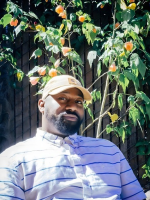
Nearly 1.3 million people are held inside state and federal prisons across the U.S. What happens to a person’s physical body inside that carceral system — and what happens after they get out? Those are questions Emile Suotonye DeWeaver has found himself up against through his life. Suotonye was in and out of juvenile hall during his adolescence before spending just over two decades in prison in adulthood.
The activist and writer tells guest host Carvell Wallace how his time in prison affected his relationship to everything from exercise and nutrition to physical touch and desire. And he describes what the healing process for his mind-body connection has been since his release in 2017.
Emile Suotonye DeWeaver is the author of "Ghost in the Criminal Justice Machine: Reform, White Supremacy, and an Abolitionist Future."
Transcript
PLEASE NOTE: This is a minimally-edited transcript that originates from a program that uses AI.
CARVELL WALLACE: This is Embodied, from PRX and WUNC. I’m Carvell Wallace. Emile Suotonye DeWeaver went in and out of juvenile hall during his adolescence…and spent just over two decades in prison in adulthood. That time behind bars had a big influence on his physical body.
EMILE SUOTONYE DEWEAVER: All of the adaptions that my body has made over the years in these conditions that it has been subjected to are very smart adaptions. They kept me safe. It kept me alive. It kept me sane.
CARVELL WALLACE: Today on Embodied: the activist and writer shares how his time in prison affected his relationship with everything from exercise and nutrition to physical touch and desire…and describes his process of healing since his release in 2017.
EMILE SUOTONYE DEWEAVER: I wanna open up more ways for this body to meet this world and engage with the stresses and the pressures and the yearnings than, than I currently have.
CARVELL WALLACE: The body after incarceration…Just ahead on Embodied.
This is Embodied, our show about identity, relationships, and health. I'm Carvell Wallace, in for Anita Rao. There are nearly 1.3 million people held inside state and federal prisons across the US, and every day, these incarcerated people live highly regimented lives. There are rules about when to eat, where to go, and when to sleep, all dynamics of power and control that affect not just the mind, but also the physical body.
EMILE SUOTONYE DEWEAVER: We had five minutes to eat, three-minute showers. I developed this very mind over matter kind of mentality where I could just override anything I felt in my body with my mind and do what I thought that I had to do.
CARVELL WALLACE: That's Emile Suotonye DeWeaver, and today on Embodied, we're talking about what happens to a person's body inside the carceral system, and what healing from those physical experiences looks like after getting out.
Suotonye has written and thought a lot about this topic based on his personal experiences. He was 19 years old when he was handed a sentence of 67 years to life behind bars. While in prison, he became interested in writing, and first borrowed an edition of The Elements of Style from another prisoner, and then copied published books by hand to learn the craft. And as he began to write and reflect on his life, he became involved in criminal justice reform. He participated in passing California's Prop 57, which increased opportunities for parole and good behavior credit. As a result of his community service, Suotonye's sentence was commuted in 2017. Since his release, his essays on liberation, criminal justice reform, and the body have appeared in numerous publications. His book, Ghost in the Criminal Justice Machine, was published in 2025. All of this has been a part of Suotonye's long journey to understand the connection between his mind and his body as a result of his experiences in prison. But first, there were teachings that he had to unlearn from his upbringing.
Your father was an incredibly influential force in your childhood, as were his particular teachings of Christianity. How did your father and his religion first shape your relationship to your body as a kid?
EMILE SUOTONYE DEWEAVER: My father's relationship to religion was one of, like, colonize the body. Mm. So it was about controlling the body. It was about the things of the body were bad, and the things of, like, the mind or the spirit were separate from the body. So there's a lot of j- just- Mm ... normalized disembodiment. It's, it's interesting the way you describe, like, prison being, like, such a control function for the body. But often when I think about it, it just feels like the way that I grew up in Western norms and then what I experienced in prison, like, one was just a continuation of the other for, like- Mm a person in my, uh, in my positionality, which was, like, a young Black boy in America.
CARVELL WALLACE: Can you give an example from your childhood of, like, sort of how those messages about your body, like, manifested themselves in your daily life?
EMILE SUOTONYE DEWEAVER: Yeah. It's like, you know, there's a very common saying in my family of like, you know, "Boy, that's just the devil in you." Anything that, like, that I wanted or I enjoyed that wasn't aligned with whatever they were preaching in, like, the, the pulpit was like that, that, that's the devil and you have to fight that. Mm. Um, from, from sexual urges to, like, to, like, too much candy. Mm-hmm. Mm-hmm. So it, it was always a, it, it was always a game of like the body is a thing to be controlled. The bo- Mm. And the s- and then in the same way it's like, like in Genesis in the Bible it's like, you know, the story is, uh, Go- God created the world and then gave it to Adam, and then Adam had, like, dominion over the Earth, and that's the same kind of relationship we were encouraged to have with our body 'cause the body, my body was also the site of my identity as a, a, a boy who was supposed to be becoming a man. So it's like- Oh ... um, you need muscles. You need to exercise. You need to push yourself. You need to be bigger. You need to be strong. You need to get calluses on your fingers. Mm. You need to, uh, do hard labor. You need to do all of these things to, like, toughen your body and discipline your body.
CARVELL WALLACE: Hmm. You know, you got pulled into the criminal justice system when you were 12 years old, and you were in and out of juvenile detention centers th- throughout your adolescence. But before we get into the impact that that had on your physical self, can you tell me a little bit about, like, the circumstances that led to you being drawn into this system at such a young age?
EMILE SUOTONYE DEWEAVER: Yeah. It's, uh, it's often a hard story for a lot of people to understand 'cause, you know- Mm-hmm ... my dad was a doctor. My mom was a professional. They got divorced really early. She ended up going back to law school. So, like, both of my parents are professional. I was very educated. Like, my dad taught me to read before I even started school, so I was hyper-literate. But the, the... I also came from, like, a house that was, like, deeply broken by domestic violence. So I had this figure in my father who, like, had to have had the, the, the wisdom to keep me on the white track, but he didn't have my trust. He didn't have any of our trust. Hmm. We were afraid of my dad. So my home wasn't a safe place, and that combined with, you know, the... In the early years of my life, I generally... My dad generally sent us to, like, all-white private schools, so there was, like, a lot of, um, racial dynamics that were very isolating- Hmm ... and alienating. I remember going to school in Pleasant Hill and, you know, getting chased home by skinheads sometimes and, you know, my older brothers- Mm-hmm ... like, fighting to... So the... While the young- while us, the younger kids, were, like, running to BART. So there was, like, a lot of, um, there was a lot of isolation. There was a lot of resentment. There was a lot of mistrust. There was a lot of not having anybody to, like, turn to or go to. And then there came this point where it's like, uh, by the time I was, like, in fifth grade, I realized I could get kicked out of school. So I just started, like, really acting up to get kicked out of all these schools with the goal of, like, wanting to, like, go to a public school, like, in Oakland, in my neighborhood, with people- Hmm ... who look like me. And- I eventually succeeded, but then I also found myself, like, caught between two worlds. I didn't quite fit in with, like, uh, my peers who were, like, Black boys, and I didn't f- definitely didn't fit in with my peers who were, like, white. And so I was in this s- disembodied kind of place where I was, like, trying to figure out who I was and, and, like, what it meant to be Black in this world, and I really didn't have any guidance beyond, like, media. So I started drawing my guidance from, like, how to be Black and how to be a man from, like, NWA, and-
CARVELL WALLACE: Mm-hmm
EMILE SUOTONYE DEWEAVER: um, you know, by the time I was about, like, 12, I had started my cycles of running away from home and, like, running away from my dad, and, you know, 12-year-olds can't get jobs. Uh, so I ended up going to the streets and, like, suddenly started selling weed and then started selling crack. Um, and that entered me into a world with a different set of rules where, like- Mm-hmm everything I had learned about controlling my body and dominating my body came in quite handy, 'cause then I could perform this thing that I thought- Mm ... I was supposed to be, which was, like, this gangster, this, like, tough guy, this, like, uh, like, this dude that don't play. And, you know, further double down on the lessons that I learned in church and then double down on the lessons that I would later learn m- moving in and out of juvenile hall and correctional facilities.
CARVELL WALLACE: Mm-hmm. I'm curious about the experiences you had in carceral systems as an adolescent that affected your physical body. You were in both short-term county-run detention facilities, juvenile hall, and then you were in a state-run youth prison system called the California Youth Authority. What kind of rules were placed on your physical self once you were in those systems?
EMILE SUOTONYE DEWEAVER: Yeah. Well, I, I guess my journey in correctional institutions as a child was juvenile hall repeatedly then, um, what they call camp- Mm-hmm ... uh, which is kind of like a combination of a work camp and just like a getaway from society camp. Um, I ran then I, I ran away from camp when I was 14, and then that's was my first trip to the California Youth Authority when I was 14. And the rules were, like, exercise. Like, y- y- you had to get strong. One of the ways that you garnered respect was being physically fit, so, like, exercise was a very big part of my life. Like, lots of pushups, lots of burpees. When we had weights- Mm-hmm ... it was, like, lots of weights. Meal times were, like, timed, and we had, like, five minutes to eat. Um, so, like, I learned to eat very fast. So there was that aspect. There was three-minute showers. It's like a minute to get wet, minute to soap off, minute to rinse off, and then you dry off outside the shower. And then everything was just, like, very, like, structured and regimented. Most of the time you spent in your cell. In my cell, I used to, like, be a human radio. Like, all the songs that I would remember, I would just, like- Mm-hmm ... perform them for myself. And yeah, that was, like, life. It was just, like, on repeat, lots of sameness. And then the other thing- Hmm ... that I learned is, like, to b- h- I... It was my practice ground of, like, learning how to be violent on call. Because- Hmm ... on one level you can't, like, allow someone to test you. On another level, like, that's what we all thought, and then we all grew up, and we all saw each other in prison, and we all figured out that we were all scared, and we were all pretending, and we were all performing, which is-
CARVELL WALLACE: Hmm ...
EMILE SUOTONYE DEWEAVER: wild and kinda sad that, like, everyone is like, "I have to do this to survive," but nobody wants to be doing it. If we could all have that glimpse into each other in those moments, we would all know that, like, none of us wanna be doing that, but we were always thinking that we were the odd person out, like we were the weirdo, like we were the weak one, like we were the secret coward, and we just had to fake it until we make it. But we're all kinda faking it till we- Hmm ... ma- made it. But yeah, like, I had to learn. I never loved fighting. Like, fighting was always, like, a very scary thing for me. Uh, especially considered, like, it was probably triggering some of the trauma that came from my house with my dad, like- Mm-hmm ... you know, abusing my mom and, like, abusing us in the ways that he did. But I had to- Hmm ... learn to just, to, to, to, like, colonize my body and be ready for violence, to commit violence, and I developed this very mind over matter kind of mentality where I could just override anything I felt in my body with my mind and do what I thought that I had to do.
CARVELL WALLACE: Just ahead, we'll talk with Suotonye about how prison influenced his relationship to his physical health and when his healing journey started. You're listening to Embodied from WUNC, a broadcast service of the University of North Carolina at Chapel Hill. You can also hear Embodied as a podcast. Follow and subscribe on your platform of choice. We'll be right back.
This is Embodied. I'm Carvell Wallace, sitting in for Anita Rao. Today, we're talking about what happens to a person's physical body inside the carceral system, and what healing and recovery from those experiences looks like after getting out. Writer and activist Emile Suotonye DeWeaver had been in and out of incarceration since he left home in his early teens. On the streets, he turned to drug sales and gang life to support himself, until at 18, he shot and killed a man. He was convicted and sentenced to 67 years to life in prison. While inside, Suotonye dedicated his time to writing, personal improvement, and criminal justice reform, and after serving just over two years of his sentence, he was released from prison for good behavior. But the experience had a profound effect on his relationship to his physical body. At the time he was sentenced, standard procedure in county jail was that when a person received a life sentence, they were moved from a shared cell into solitary confinement. That moment was emotionally and physically devastating for Suotonye.
EMILE SUOTONYE DEWEAVER: When I was sentenced to 67 years to life and put in solitary confinement, it felt world ending. Like, it felt like this implosion- Mm-hmm ... kinda like this implosion into, like, this endless black hole where, like, everything just drained into that, and it was this deep, heavy hollowness. It was that. It was also, like, my life flashing before my eyes in the courtroom before they even got me into the solitary confinement cell. And it was j- there was just a deep level of despair and, um, hopelessness for a period. And, you know, true to the patterns that I'd been taught, like, I created this... I, I, I retreated to my mind. I, I, I left my body. I retreated to my mind. Then, and before then, and, like, many years after that, my mind kinda became the citadel 'cause the body wasn't a safe site for me to be and operate. And so, like, in my mind, I resolved that, like, I was gonna figure out how to get out of prison, and I was gonna become a writer, and I was gonna write my way out of prison, and that didn't happen the way I thought it would happen, but it, it did happen. Uh, and so there's this way in which I created this, this delusion for me to live in that I just lived into until it became real, and it was powerful, and it was important, and it saved my life, but it was a very often disembodied experience.
CARVELL WALLACE: Mm. You know, to set us up more to talk about what happens to your body over ultimately what was two decades behind bars, I wonder if you could give us a physical d- description of the conditions you found yourself in. What were the spaces that you lived in like? What were the routines of daily life?
EMILE SUOTONYE DEWEAVER: Yeah. I mean, in best case scenario, it was like a 9 by 12 cell. There were cells that were smaller, and sometimes there were cells that were a little bit bigger. But essentially, we're talking about a small concrete room with a bunk bed, or in the case of solitary confinement, a single slab of a bed, a toilet, a sink, and a mirror. And the toilet and the sink are a connected unit. And then on the, on the wall where your bed is, there's generally like a shelf, like a s- like a metal shelf, uh, where you can put your belongings and your things. And in some cases, there's also like a, a writing desk by a wired window. Not in solitary confinement, but in general population there'll be a writing desk. I'd spend the day like writing or learning to write or writing a story. I had time where I would exercise, um, and that was for the most part like my day. I got my hands on like a typewriter, and so like I'd spend my days like writing or, um, when my typewriter ribbon would run out, then I would like crack it open and like rewind it by hand and reuse it. Mm. And, uh, so yeah, I spent most of my days reading, writing, exercising, occasionally making wine, and only leaving my cell when like I like had to. Like you couldn't hide out in your cell uh, uh all day because then that would, um, suggest that you're afraid to come out of your cell. Mm-hmm. So like when there were times to come out the cell, I would like go out my cell, you know, play pinochle or chess, uh, go back in my cell, get back to work.
CARVELL WALLACE: Hmm. How did you take care of your physical health besides exercise? Like, you, you've written in an essay that you, you, you talked about how incarcerated people tend to avoid clinicians and avoid doctors. Tell me about why that is and, and what your relationship to doctors was like while you were in prison.
EMILE SUOTONYE DEWEAVER: Yeah. In prison, you avoid doctors because they charge you. Like, you have to pay $5 to go see the doctor. I don't know if that's the way it is now, but then you had to pay $5, and, like, $5 is, like, a month's wages. It's, like, almost everything. If you have a prison job that's, like, $5 is, like, your whole month's wages for some jobs. Mm-hmm. And, like, the better jobs, maybe it's, like, half your wages up to- Mm ... like, a quarter of your wages. So, like, you know, out here, if you're making a couple thousand dollars a month, it'd be like going to pay $1,000 for a copay. Uh, so people- Mm ... avoid the doctor for that reason. And then people also avoid a doctor 'cause you, you pay all of that money, and the doctor really doesn't, like, do anything, right? There's, there's not really a whole lot of, like, care for you. There's, there's this old joke in the Youth Authority that we had, Reading, was like, you know, you go see the doctor, the doctor's just gonna tell you, "Well, drink more water." Like, it's like, yeah. Like, "I have this horrible rash and my head is killing me." He's, he's like, "Yeah, drink more water." It's like that was the prescription for everything. Drink more water. Mm-hmm. Um, so I, I think a lot of people would pay if it was at least, like, medical care, but given that it wasn't even medical care, it's like people would just avoid it. Hmm. So that, that's like the, for the physical stuff. For, like, the mental health stuff, people avoid it because, like, there's no such thing as, like, doctor-client confidentiality in prison. Whatever you say can come back to bite you in a, in a board hearing, and you, and you will get denied parole, uh, for what you've confided in, like, your doctor for, with. So people avoid that. I avoided things like medication, 'cause medication is also another thing that can come back around at board and keep you from getting paroled. Hmm. Because what they're assessing is whether you are a safety threat to the community, and if you are on medication, there's an argument that you're a safety threat.
CARVELL WALLACE: Hmm.
EMILE SUOTONYE DEWEAVER: So that's kind of the medical situation. So, like, how did we stay healthy? How did I stay healthy? Like, I exercised- Yeah ... a lot. I tried to eat as healthily as I could, and that has had its ups and downs. I was vegetarian for a while, and that was its own journey that involved like court battles and everything, 'cause it was like a- Hmm
like a religious practice. I did a lot of meditation. Uh, I think that's the single most powerful thing that went towards like keeping me sane and keeping me grounded, was like a lot of meditation. A lot of meditation, a lot of exercise, and a lot of, uh, like poetry and a lot of reading, and the relationships that I would slowly build with people who were, who, who were like reaching for something similar to me.
CARVELL WALLACE: Hmm. What does it mean to try and eat healthy in, in a, in a prison? I mean, what, like, what is it... How do you do that?
EMILE SUOTONYE DEWEAVER: For me, like a lot of people, the food's not good in prison, so. Yeah. But, you know, my father gave me the gift of, like, ironclad taste buds because he was a horrible cook. Uh, so, like, I love great food and I will eat and enjoy great food, but I'm also a straight up functional eater when I need to be- Mm 'cause I can be. So in prison, like a lot of the, you know, the soggy like vegetables and stuff that most people would be like, "Oh man, I'm not eating this," like, I'd be like, "Here. Shoot it. Shoot it. Give it to me." Mm-hmm. Mm-hmm. And I would eat it because I could. Uh, so I ate as many vegetables as I could, and that was like the extent of it. In those times where, like, I was going to canteen or getting packages, that makes it a little bit easier to, like, supplement your, your diet because you can get like pouch foods, different like straight proteins like fish or crab or chili and things that, like, you can kinda cook in your own cell with, with like a rigged up hot pot.
There, there's also a black market of food in prison. And then, like the, the gold standard- Hmm ... which I'm, uh, which I'm using right now, like I usually don't eat or do anything I associate with prison, but here's the exception. The, those, those Ensure drinks. Uh, like that was- ... the holy grail in prison. If you could get your hands on Ensure- Mm-hmm like you- Mm-hmm ... you were living like a prince and I, I, I put- Mm-hmm ... Ensures in my smoothies these days.
CARVELL WALLACE: Mm-hmm. Yeah. That makes sense. One thing that strikes me hearing your story, I mean, I have so many thoughts about this, but one thing that strikes me is like I... It's hard to imagine going that long, like h- how physical touch works in prison if you, if you're facing an incredibly long time, that sense of like physical isolation. Uh, what was your experience with physical touch in prison? Uh, how much, you know, like how did you deal with that very obvious and strong need?
EMILE SUOTONYE DEWEAVER: Yeah, there was almost no physical touch in prison. And when you cue that question up and I remember the reality of that, like I can feel it from my legs- Mm ... up to the top of me, just the, just the, the pain of it, like the, the h- the horror of it. And I think it's bad for anyone, but it was particularly bad for me. My d- my dad used to always tell me that like, you know, that I was like kinesthetic which meant that like I related- Mm ... very deeply to the world through touch. Mm-hmm. And I related to people through touch. Mm. And so to not have that for like decades at a time aside from like the odd dap, the quick hug, the fist bump- Mm-hmm That was just soul destroying for me. Like, it's, it's a thing that like, you know, I still live with even though I'm out here and I have access to people who love touching me. It's a deep grief. It's a deep scar. Hmm. It's a deep It's a deep sadness that, that I still live with. It is 20-plus years of deep deprivation that even in my life that doesn't involve that, I still feel it. I still experience it.
CARVELL WALLACE: What does that cost a person, do you think? In your experience, what does that loss amount to?
EMILE SUOTONYE DEWEAVER: I mean, it's har- it's very hard to describe. Like, I'm clear about what it costs, but, like, do we have the language to describe it? It's, um- Mm-hmm ... I would compare it to, like, the way that I was raised in patriarchy, and I remember, like, in my late 20s to early 30s when I came to my own disillusionment about, like, patriarchy and what it had taught me and how it had taught me to destroy everything that I was actually reaching for. And- Mm-hmm ... and I was focused particularly on the aspect of, like, how I have spent all my life rooting anything even tangentially associated with femininity out of me and trying to kill it. Mm-hmm. And I came to this really, like, really heartbreaking point in my cell where I realized that there were things about me that were dead that I didn't even know it was dead, and it's the kinda loss that's hard to describe because you don't even know what you lost, right? Right. It's like been, it's been happening for so long and so reflexively that I don't even know where to go to resurrect them. Mm-hmm. And with touch, it feels similar. It's like, and it comes, there comes a point in that cycle of trauma where it's so much and then you tune out and get so distant that you're not even there to keep track of what you're losing anymore. So when you come back to it, you just feel the big gap. You feel the big hole- Hmm ... but it's like all I c- all... I can define it by its emptiness. I couldn't tell you what it was, and that's just another layer of grief to, to lose- Right ... parts of yourself and not even be able to put them to rest because you don't even have an identity for them.
CARVELL WALLACE: Right. We're gonna talk more about how a person sort of recovers from that, like, gets, gets that back later in this talk, and I... But for now I'm, you know, y- I guess I'm curious about desire, right? Like, you're talking about, you know, uh, we experience often desire as, like, th- a desire for something that's missing. And in the missing of physical touch, it occurs to me to ask, did you desire and how did you deal with desire while you were in those circumstances?
EMILE SUOTONYE DEWEAVER: Like, while I was in prison?
CARVELL WALLACE: Mm-hmm.
EMILE SUOTONYE DEWEAVER: I mean, there was a journey there. When I was... I got transferred from the county jail to prison when I was, like, 19 or 20, and I remember, like, knowing that desire is important to me, connection's important to me.
Like, touch, sex, all these things are very important to me. I had resolved early on that I was like, "Okay, well, like I'm in prison. I'm just gonna, I'm gonna live a prison life," which meant to me, like I didn't have a framework for like queerness. I didn't have a frame- a frame for like trans people. It was just like gay or not gay, right? And so in my mind- Mm-hmm ... it was like, "Well, I guess I'll, I'm gonna like go be gay because like I don't, I'm, you know, I'm not gonna spend the rest of my life not in like physical contact with anybody." And I had this experience with this trans woman in my like first couple months in like San Quentin's like reception center, and it, it was fraught 'cause, you know, I had a lot of internalized homophobia.
CARVELL WALLACE: Mm-hmm.
EMILE SUOTONYE DEWEAVER: But, but, but, but it was a connection, and the thing that kept me from continuing to like pursue that connection was like, uh, like a lack of frameworks in which to do it in. Mm. Because it was a trans woman, but to me, it was just like a gay man pretending to be a woman. Mm. And even though when I like left this person's cell, I felt like, well, you know, I got what I needed out of the, out of the encounter, but when I was like sitting in my cell thinking about it, I was like, "Well, you know, like you don't really like control who you develop feelings for if you're like having sex with them on a consistent basis." And in my mind- Mm ... I was like, "Wow, how up would it be like if this person fell in love with me?" And to like fall in love with someone who's pre- who's, who's like has affection and care for you On, on a false premise. That false premise- Mm ... being that, like, what this person wants is a woman, and you're a man, and you guys are pretending, and it just felt like, wow, that would be... Like, I'm putting myself in that situation, that'd be soul-crushing to be in love with someone who, like, couldn't see me and, and, and, and needed me to be someone else other than who I was to be loved. And so that just felt like- Mm ... deeply unethical to me. And so- Mm ... I was just like, "Well, okay. You're gonna have to give that up," right?
And that, that, like, that's not a thing that you can pursue and be in integrity with yourself. And then so after that, it was just like, you just have to bear it. You just have to deal with it. You just have to take the lessons that you got from the church and Western civilization and your father- Mm ... and capitalism and just, and, and deny yourself and, like, basically colonize your body. And like, you know, after a couple years it just, it just wasn't a thing because, like, I'm, I'm very good at- Mm ... colonizing my body. Um, uh, so that's kind of like half a witch.
CARVELL WALLACE: You learned from the best. Yeah. Yeah. Yeah. I'd like to talk a little bit about some of the rethinking you did of this messaging and this reconnecting to your body that happened largely after you got out of prison. So, you know, during your sentence you had been involved in community service and activism, supporting the personal growth of incarcerated people like yourself, and you'd also been doing a lot of writing. And you wrote a series of essays that you sent with letters of support to California's then-Governor Jerry Brown. In 2017, your sentence was commuted by the governor, and you left prison after two decades at the age of 39. So when did you start realizing that there was a journey of healing to be done, specifically with regards to your physical body?
EMILE SUOTONYE DEWEAVER: It was maybe, maybe a year before I got out of prison. And at the time, my partner, she had, like, lots of connections with people involved in generative somatics therapy, which is a focus on getting out of, like, talk therapy and, like, you know, the mental models of healing and then straight into the physical models of healing. And, like, a simplified explanation would be, like, we're familiar with the mind as it exists in the head, but there's also, like... This is an oversimplification, but the body has a mind as well. Mm-hmm. Um, and in the same way that we treat mental illness in the mind, we also have to treat mental illness in the body if we're ever to, like, heal over it and move past it. So it's something that was on my radar as, like, "Oh, this is a thing." When I got out, I got involved in it, and I had this incredible practitioner, Mawu Lisa, who just, like, changed my life. And I got to her after trying talk therapy, which was just, like, no good, no good for me- Mm-hmm ... because, like, my mind was already my citadel, right? Like, there's like- Mm-hmm ... there was no, there's, like, no circumstance where grounding in my mind is gonna put me in a place where, like, I can feel vulnerability, because I'm just too strong there. Like, I'm too capable there. So there's no growth really available there. But when the body was the site of my work, like, I was like a child. Like, I was just, like, as vulnerable as it could be, because I-
CARVELL WALLACE: Mm ...
EMILE SUOTONYE DEWEAVER: had no, and sometimes still feel like I have no idea what I'm doing. But that is the place, uh, where you find your truths and find your growths, and you find all the things you've been hiding from, because, like, you've been hiding them in your body.
CARVELL WALLACE: Just ahead, we'll talk about how Suotonye got back in touch with physical needs and desires, and healed his mind-body connection after two decades in prison. We'll be right back.
This is Embodied. I'm Carvell Wallace in for Anita Rao. In 2017, Emile Suotonye DeWeaver was released from prison after serving 21 years of a 67 years to life sentence. Suotonye had become a writer and an activist for criminal justice reform during his time in prison, and his sentence was commuted by the California governor because of his transformation and service. After he got out, Suotonye began rebuilding a life and deepening the connections that he had made with activists and friends during his time behind bars. And one major source of healing and growth was in his relationship to his physical body, which he began with the help of a somatic practitioner.
EMILE SUOTONYE DEWEAVER: I got introduced to centering. I got introduced to, like, using my body as a compass. Like, generally, like, you know- Mm ... I've been taught that, like, when I'm making decisions, it's like, do you wanna do this thing?
And I'm trying to think my way to an answer. It's like, do I want this? Do I like this? Do I want ice cream? Do I want more pie? Do I... But there's this other technique of just really grounding in the body and following the feelings. Like, what do I feel when I think- Mm ... about this offering? Like, you know, I might be on a date with a person and trying to figure out, like, what I want from them or with them, and there's a way in which, like, I can think my way through it, and that usually is gonna take me to a place that's about what I think I'm supposed to want. But it- Mm ... also just sitting in the quiet of my own body and asking my body and giving it space and room to emerge with an answer, which usually comes in the form of a feeling or in the form of- Mm ... like, tightness or discomfort. I can also get answers in the, the, in the feeding cycle of listening to the body and then affirming the body, like, like, getting tight. Like, do I wanna kiss this person? Like, they're very hot, right? And I, and, you know, I'm supposed to wanna kiss them. Mm-hmm. But, like, what is this tension that I feel in my armpit? Uh, why is my breath so constricted right now? Maybe it's too soon for that. Maybe you don't want that right now. You want the connection, but you don't want that. And then listening to that, and then the body becoming accustomed to being in relationship with you and being honored, given that, like, it's been so long since I've honored it, right? So the, um- Mm-hmm ... giving it its feedback loop to know that it has space here and it is valuable here. Another practice that I developed with the body is, like, deep gratitude. Like, you know, we go to therapy and whatnot, and we have, like, these different patterns, whether they're attachment styles. And sometimes we can view them like they're in our way, like they're holding us back from, like, being our best self or something like that, and we can get angry and become at war with ourselves. But, you know, one thing that Mawu Lisa helped me understand is just, like, is- is how grateful I get to be to my body because of how smart it was. Mm. Like, all the, at my- all of the adaptions that my body has made over the years and these conditions that it has been subjected to are very smart adaptions that kept me safe, it kept me alive, it kept me sane. Mm-hmm. Mm-hmm. And so that's something to be grateful for. That's something to give love for and appreciation for, and I can do that at the same time that I can acknowledge that, you know, the thing about the body is, like, the body's not really good at telling truth from, from false, right? Like, everything's real to the body, right? Mm-hmm. Sure. But- and the thing about it is, is when it finds something that works, it just does it, right? It just does it over and over, and so the relationship shift is like, "Okay, okay. One, love you, body. Thank you so much for taking care of me. And also- Mm ... can you trust me to take care of this," right? I know that this works, and this is a great tool that I am gonna deploy sometimes, but I wanna have a choice about when I deploy it. Mm-hmm. Mm-hmm. And I wanna open up more ways for this body to meet this world and engage with the stresses and the pressures and the yearnings than I currently have. Mm. And so that relationship of gratitude and cooperation, uh, has been, like, another big way that I've come back into relationship with my body.
CARVELL WALLACE: You know, you're talking about such an advanced form of wisdom that I think is, like, high-level stuff, right? And I'm, I'm curious about how this has changed your experience in the world, right? Like, you've talked a little bit about how you got there through, like, working with practitioners who excel in this, and by developing a kind of, like, living practice of, like, interacting with the body in this new way. But I also wanna know how that- what that makes available to you in the world. Like, what can you do now that you didn't used to be able to do?
EMILE SUOTONYE DEWEAVER: I think one of the things that I can do now that I couldn't do before is I find so much more joy in presence, and I find so many more instances of joy. Like even taking, for example, the cooperative model, like with my body of like, "Thank you, body," like gratitude. There's so much more love and therefore joy in that than this idea of like, "Body, I have to conquer you 'cause you're in my way." Like that takes a lot of energy. Like, like that takes a lot of energy. It's a bit like self-mutilation. Mm. So it's like, one, it opens up so many more pathways of joy. Two, it was maybe the first material step I took towards decolonization. There were intellectual steps that I had taken towards decolonization- Mm ... when I came to my realizations about patriarchy, when I came to my realizations about homophobia, but they were, they were an idea with no roadmap. But when I Began to change my relationship to my body. I began to see... Like, there's a reason why we're out of relationship with our body. It's kind of like the enemy of my enemy is my friend kind of thing. And so in that note, it's what led me to my, uh, ancestral practice. It's what led me to a deeper embrace of, uh, what I would call, like, magic in this world, what other people might describe as just reconnecting to, like, this Mother Earth. All of these things for me were accessed through a deeper relationship with my material body, which gave me a deeper relationship to the material body of this world, of Earth, of, like, trees- Wow ... of dirt, of, like, ducks. Of like, you know, of everything. And, and it's a real relationship, and it's powerful, and there's a lot of- Hmm joy in it. Even when I'm in deep sorrow, there's a lot of joy in it 'cause there's the- Hmm ... which is not something that I... I, I've always been a very joyful person, so I've experienced joy in prison. I've experienced joy living on the streets. But I've never been able to experience joy and sorrow at the same time. It's, like, extreme in one direction or another. But this- Hmm ... being in contact with my body has given me the ability to feel a lot of different things at once that don't necessarily go together, but they also don't destroy me because they don't need to go together. They can all have their own loving space to be in me, and I think that that is particularly important for, like, the young Black boy in me who was raised to hate himself by everything that was in my culture.
CARVELL WALLACE: Wow. I mean, so much of what you're talking about is, like, is reaching me on an incredibly deep level. And one thing I've always struggled with in my own life, and even, like, literally right now I'm, like, sort of working through this and talking to people about it, is that I have this, um, internalized belief that if I ever did anything wrong, that counts against my right to pleasure. That actually that I'm my own judge, jury, and executioner. I'm my own punisher. And it strikes me as so profound that you feel allowed, that you've allowed yourself, if that's the right word, which it's not, to experience joy and pleasure, and even just reconnect with your body even though you have done something that, like... You're an empathetic person. You're a caring person. You're a caretaking person. You've done something that, that I'm sure has caused complex feelings, guilt, self-hatred, whatever it is. I'm curious about how you rebuilt the part of the self that allows you to feel pleasure and joy, and how you kind of quieted that part of yourself that probably wants to say, like, "I don't deserve this because I, because I've done bad things."
EMILE SUOTONYE DEWEAVER: I mean, the honest answer is, like, how did I do that accidentally? I think, you know, the f- the, the, the first thing had nothing to do with me. Like, 'cause like I was ... Y- you know, coming to terms with having, like, killed a man, like I had... I remember a point, maybe late 20s, where I felt like I was at peace with it. Yeah, I didn't feel great about it, but I was at peace with it, right? Like, I know it's not a bell I can unring. But I can- Mm-hmm ... decide to live differently from that point out. And I remember, like, I was in, um, this place called Solano State Prison up in Vacaville. Mm. And in prison we're not, like, allowed to, like, communicate with each other, but of course we do. We, we, we send, like, little secret notes that we call kites. So this youngster- Mm ... like, you know, sent me this kite from another yard, and he was from my neighborhood, and I had never met him. I didn't know him. He was too young for me to ever have met him, but he knew me. And he sent me this kite where, like, he essentially kind of worshiped me, and he was telling me that, like, you know, he was over there on the yard. He was, like, representing for the turf and, like, you know, people are still talking about me, and there's still so much love, and, like, all this stuff. And, like, I'm reading this letter, and I'm just, like, horrified 'cause at this time it'd been, like, almost 10 years, right? And, like, I felt like- Mm-hmm ... I, you know, I had my life together. I was headed in the right direction. But here I was seeing the reverberations of, like, an action that I had take still affecting this world in some very destructive ways 'cause I saw in this young kid me, and I saw where he was headed. And it was like, oh, my God, this, this young kid, in another four or five years, like, he's gonna be doing a life sentence like me, right? And so I, I had this, like, panic, um, that really kind of broke me open, and that became a point where, like, I had this realization that, like, wow, if you have the power to cause this much destruction, then you also have the power to cause this much good. And so that became a shift in my life from working for myself to working for my community, for working for my people. And so I would say, like, the first step in that process that you're asking me about is that, like, I found something bigger than myself, something outside of myself, which sounds counterintuitive- Mm ... 'cause we're talking about embodiment, right? But we're all interconnected. Like, your body- Mm-hmm ... is a part of my body, right? If I cannot- Mm-hmm ... respect the health of your body, then I am not respecting the health of my body. I am doing harm to my body when I do harm to your body. So I think that's where it started for me is, like, getting outside of myself.
CARVELL WALLACE: Hmm. I, um, first of all, thank you for that. I just- I'm gonna take a moment. I'm actually just gonna take a moment with that. That's all. I wanna ask you a little bit about, um, something that you have written in an, in an essay that's kind of been stuck in my mind. You wrote about something you experienced at a Walgreens when you observed a security guard apprehending a m- man for shoplifting, and you, you wrote that that observing that scene brought up a phrase that has s- really strikes me, which is awakened trauma. Like, the idea that, like, trauma is there dormant, and a situation unbeknownst to us can just pop up and, and bring that up. How do you deal with those physical manifestations of trauma that still p- maybe pop up in your life now?
EMILE SUOTONYE DEWEAVER: Mostly I slow down because, like- Hmm ... you know, if it pops up, it caught me off guard.
And so, you know, I believe, like, the worst thing you can do when, like, caught off guard is to, like, rush forward and ahead. Hmm. So when like, uh, I feel like the, the latest example of this is a friend of mine was, like, staying at my house, and she was talking to me in the kitchen, and we were talking about, like, our relationship to, like, at least my relationship to wanting children or not wanting children. And it came to- Hmm ... this point where, like, I was talking about, like, the bad decisions that, like, my parents had made, and just saying the words, like, hit me. Like, I felt it through my whole entire body. Oh. Like, I like, like, like the tears started, like, coursing through my under skin and, like, you know, it just kind of like sh- Hmm
shadowing in my eyes, and it was, like, a lot. And what I did was I just kind of like, you know, I just, like, sat with it, you know, named, like, what's going on and, like, to my friends, like, "Well, I di- I didn't quite expect that, and now it's here." Uh, and you know, she just kinda sat with me with it, and I just, like, sat with it and, you know, talked about it a little bit and then moved on to, like, what we were talking about. But yeah, like, s- stuff comes up, and it hits me, and I feel like my most common response to it is to, like- Resist meaning-making, resist categorizing, resist, like, talking myself down or explaining it away or bla- or trying to, like, figure out some framework that makes it okay, and just, like, breathe and be in it. Like, be really present- Mm ... in it. Because I think that one of my habits from the days of yore is not being present in it, and then that's how I would pack it away as different, like, dysfunctions into my body, right? But rather than- Right ... doing that, I try to feel as much of it as I can, and if it becomes too much, I have my tools. I can retreat and come back and visit it. But I, I think my goal is to, like, feel it, so 'cause I associate feeling with processing it, right? And then after feeling it, my goal is to, like, talk about it because I also associate talking about it with processing. So that, that's kind of- Mm-hmm ... how I, how I deal with it. In the case of this essay, sometimes I write about it, right? And so that's also- Right ... it's, it's own form of processing.
CARVELL WALLACE: So we talked at the very beginning of this conversation about how y- you were taught as a kid that your body was something to be controlled. And this is something you and I have talked about elsewhere, and I've written about this, and it's like a recurring theme that, you know, the ways in which particularly... I mean, I assume this happens for people socialized as girls, but as a person who was socialized as a boy, I can look at my past and be like, "Here's all the ways that that I was messaged this thing." I know you can't change the past, but if you could go back and talk to your younger self, what is the reframe that you would, would give him about the type of relationship that he actually can have with his body?
EMILE SUOTONYE DEWEAVER: Oof. If I was talking to my younger self, I think it would start with a long hug. And what I would tell him is, "You're living in a world that's always gonna tell you that this self-denial that you're doing is, like, the right way to live. That's a lot of pressure. You don't have to listen to that. If you do listen to that, that's also okay. There's time." And I think, like, the most important thing that I would tell a young me is, uh, "Suotonye, you cannot control who loves you, but if you be yourself, if you get real connected to yourself, and you ground in yourself, and you live from that, I guarantee you people will love you."
CARVELL WALLACE: Hmm. I think that's a good note to end on. Emile Suotonye DeWeaver, thank you so much for this conversation.
EMILE SUOTONYE DEWEAVER: Thanks for having me.
CARVELL WALLACE: Emile Suotonye DeWeaver is the author of Ghost in the Criminal Justice Machine: Reform, White Supremacy, and an Abolitionist Future. You can find out more at our website, embodiedwunc.org. Today's episode of Embodied was produced by Kaia Findlay and edited by Amanda Magnus. Wilson Sayre also provided editorial input. Angie Starcevic is our intern, and Jenni Lawson is our technical director. Quilla wrote our theme music. This program is recorded at the American Tobacco Historic District. WUNC is a broadcast service of the University of North Carolina at Chapel Hill. I'm Carvell Wallace, sitting in for host Anita Rao.