When the remnants of Hurricane Isaias washed over the state last weekend, heavy rain eased drought conditions in western North Carolina.
After flying through Florida and Alabama, remnants of the storm hit North Carolina on Sunday. Parts of the coastal plain region stayed relatively dry, but some areas in the mountains and foothills recorded upward of 9 inches of rainfall.
The National Weather Service confirmed that 13 tornadoes hit central North Carolina during the weekend. Along with the heavy winds, portions of the county saw significant flooding. McDowell County officials quickly responded to inundated streets and five landslides, and two people were rescued in Burke County after Catawba River overflowed.
Though the storm brought destruction, it also raised water levels in drought-afflicted counties. The North Carolina State Climate Office said groundwater levels in Pigsah Forest in Transylvania County returned to normal for the first time since January.
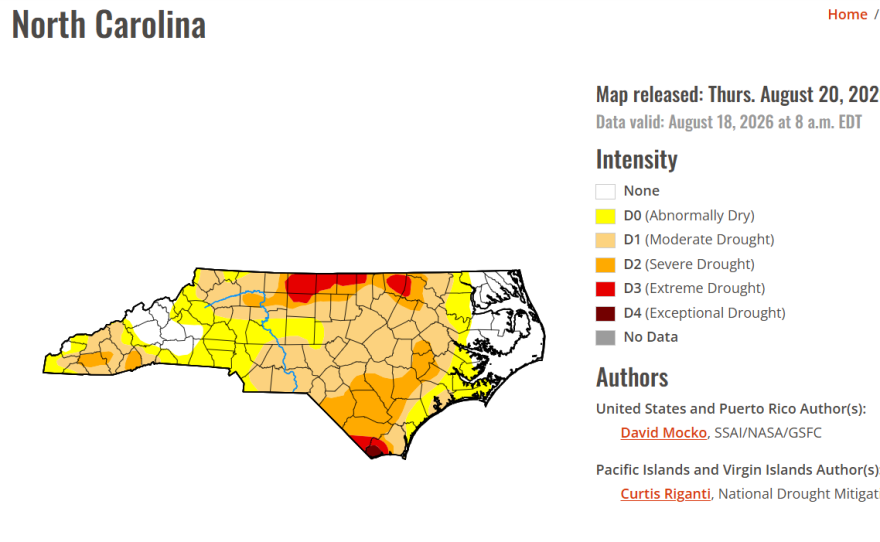
This Week's Map
Although rainfall eased drought conditions in western parts of the state, counties in and to the east of the Triangle are still in severe or even extreme drought conditions.
Most of the foothills region of the state has escaped the drought, but the N.C. Drought Management Advisory Council recorded some 22 counties in a severe drought and 8 counties in an extreme drought. For the first time in months, no part of the state is experiencing an exceptional drought.
The U.S. Climate Prediction Center expects the drought will end in the next three months.
In the gallery below, scroll through weekly drought maps to see how rain has reduced drought levels across North Carolina:




Previous Weeks
October 8
Last week's heavy rain brought relief to the state's southern counties — Brunswick County has finally escaped its extreme drought classification, and streamflow at Trent River is almost back to normal levels, according to the N.C. Drought Management Advisory Council. But the rest of North Carolina saw little to no improvement in the persistent drought.
The U.S. Drought Monitor's weekly update map shows persistent drought conditions across the piedmont. Northern counties continue to endure the brunt of the dry weather, with several counties still experiencing extreme or even exceptional droughts. The stubborn dryness has diminished yields across the state for crops like corn, peanuts, and cotton.
The Drought Management Advisory Council found that trees are now transforming into their classic autumn colors, with some species already losing leaves.
October 1
Last week, the N.C. Drought Management Advisory Council described the state as experiencing "a drought within a drought." But some mountain towns like Boone and Hickory saw more rain than usual across September, according to the council's weekly report. The rainfall brought the W. Kerr Scott Reservoir in Wilkesboro above its target level, and Lake Lure in Rutherford County reportedly had its wettest day since Hurricane Helene.
That improvement wasn't consistent across the state, however. Cape Hatteras experienced its second-driest September on record, according to the report. A swath of exceptional drought — the highest and most dangerous drought classification — remains in Guilford and Rockingham counties, and several counties along the coast saw their own classifications worsen.
Severe drought conditions spread across Wake and parts of Johnston County, and the state's most northeastern counties saw conditions shift from no drought to being abnormally dry.
September 24
Some 10 counties are classified as being in a severe drought — a significant improvement from the over-20 counties of last week. However, more than 70 counties across the state remain under a moderate drought classification or worse.
The North Carolina Drought Management Advisory Council described current conditions as a "drought within a drought" in its weekly report, especially pertaining to the eastern side of the state. The first three weeks of September were the warmest on record for cities like Hickory, Raleigh, and Washington; Jordan Lake hit its lowest levels since May.
The drought intensified in parts of Lenoir and Greene counties — in the former, the city of Kingston is in its driest six-month period since 1996, according to the state's drought management advisory council.
In western North Carolina, Cleveland County saw conditions improve, despite the region continuing to face abnormally dry conditions. Areas in the mountains saw streamflow levels surged after rainfall earlier this week, but groundwater levels remained largely unchanged.
September 17
After weeks of slow improvement, recent heat caused drought conditions to worsen in some North Carolina counties.
In eastern North Carolina, multiple counties saw their moderate drought classifications increase from moderate to severe. Streamflows on the Dan River hit daily record lows, and Asheville had its driest start to September in 10 years, according to a report from the North Carolina Drought Advisory Council.
Wake County fell back into severe drought conditions this week, but Raleigh Water's Environmental Coordinator Ed Buchan said it's unlikely the city will have to restrict water supply again. Predictions, he said, show a strong chance of recovery this winter. However, the Drought Advisory Council warns the state could see increased wildfires in early fall.
September 10
The state Drought Management Advisory Council lists 18 counties as being under severe droughts compared to 20 from last week. Regions in Cumberland County and Hoke County saw their U.S. Drought Monitor intensity classifications decrease from moderate drought conditions to being abnormally dry, with the Hoke County Extension saying crops are recovering but corn and hay yields may still be lower than normal.
However, the drought worsened in some parts of the mountains. In Jackson County, amid a return of severe drought conditions, Bear Creek Lake is 13 feet lower than its normal seasonal target.
Portions of Mitchell, Avery and Caldwell counties saw a resurgence of abnormally dry weather. Similar conditions persisted in the state's most western counties, and while some relief came to the south — Brunswick County's classification decreased by a level from exceptional to extreme drought conditions — a tract of northern counties are still under extreme droughts.
September 3
The NC Drought Advisory listed seven counties as experiencing extreme drought conditions this week: Brunswick, Caswell, Guilford, Halifax, Person, Rockingham and Warren.
However, other parts of North Carolina are continuing to see relief. The majority of Cherokee County, the state's westernmost region, is no longer under a drought, and a swath of land east of Richmond County saw conditions improve after a week of scattered rain and high humidity.
Guilford County and Brunswick County are the only regions still visibly facing exceptional droughts in the U.S. Drought Monitor's weekly map — nearly 15% of Brunswick County remains under exceptionally dry and damaging conditions.
August 27
As climatological summer concludes, North Carolina's mountains and coast are seeing an end to the state's ongoing drought. However, about 19% of the state remains in a severe drought or worse, according to the U.S. Drought Monitor.
Last week's cold front brought storms and showers to the coast; in Wilmington, over 8 inches of rainfall made this week its wettest seven-day period in two years. Across the state, McDowell County is completely free of abnormal dryness and any drought conditions, while other mountain counties like Burke and Rutherford aren't far behind.
The relief doesn't encompass all of North Carolina. The state's northern region received less than an inch of rain in the past month, as per the Drought Management Advisory Council's updated report. At Roanoke Rapids, streamflows have hit daily record lows.
August 20
A prolonged drought continues for much of North Carolina, but the mountains got some relief this week.
The Drought Management Advisory Council called it a tale of two halves of the state in this week's report. The mountains and foothills got up to four inches of rain while the Piedmont and coast were extremely hot and dry.
The recent mountain rain pulled Asheville and surrounding communities completely out of drought conditions. But five counties in the Piedmont are still in extreme drought, the second worst category. Forecasters do expect rain today and tomorrow that could help those conditions.
August 11
Businesses impacted by the recent statewide drought are eligible for federal aid.
The North Carolina Drought Management Advisory Council releases updated conditions every Thursday. This week, western and some central parts of the state moved from moderate drought to abnormally dry conditions, including Rutherford and Rowan counties.
Beginning in March 2027, the U.S. Small Business Administration will offer low-interest loans for small businesses, private nonprofits, faith-based organizations and small agricultural entities impacted by the drought.
August 4
This week, southern parts of the state, including Duplin and Sampson counties, moved from extreme drought to severe drought. The majority of the state still faced a classification of moderate drought or higher. 29% remained classified under severe drought or worse.
Throughout the state, officials' reactions to recent rainfall were mixed.
In the Triangle, Raleigh and Fuquay-Varina lifted their restrictions, while in the Piedmont, Burlington continued to keep its stage one water restrictions in place. In the northeast, Rocky Mount eased water restrictions from mandatory stage one to voluntary stage two over the weekend.
Durham officials said they were not lifting water restrictions yet. James Lim, water efficiency and conservation program manager for the City of Durham, said total water supply has not hit the trigger to leave stage two water restrictions yet.
Durham would need a significant amount of rain to lift restrictions, he said.

July 28
Raleigh officials said they will lift stage one water restrictions on Aug. 2. The restrictions were in place since April, but recent precipitation had aided water levels in places like Falls Lake.
According to the U.S. Army Corps of Engineers, Falls Lake rose by more than two feet this week. Jordan Lake increased about three feet since last week, and according to the City of Durham, Lake Michie was up by five feet. Despite the rising water levels, all three water bodies were still well below what officials normally see.
On Thursday, Governor Josh Stein said in a press release that after a dry fall last year, North Carolina also had a very dry start to 2026.
"Although recent rainfall has made a dent in the problem, we're not in the clear yet," Governor Josh Stein said. "I encourage North Carolinians to check their local water system’s conservation status and do their part to use water wisely."
"It may seem odd to talk about drought and continued water conservation after days of very wet weather, but we need to make up for months of extremely dry conditions," DEQ Secretary Reid Wilson said in the same press release.

July 21
Summer storms continued in North Carolina, though still not enough to end the state's drought.
This week, Alamance, Orange, Caswell, Person, Durham and Granville counties all moved down a classification, from exceptional to extreme drought.
Guilford, Rockingham, Brunswick and Columbus counties remained in exceptional drought. According to the U.S. Drought Monitor, an estimated 58,098 people were living in areas affected by drought conditions.

July 14
10% of N.C. counties in the extreme drought category moved to a lower classification.
Seven central North Carolina counties remained in exceptional drought, including Orange and Durham counties. Brunswick County near Wilmington also remained exceptionally dry.
Local storms brought rain, but the Drought Management Advisory Council said this week should be treated with cautious optimism. Rain was very hit-or-miss, and it didn't go far enough to end this entrenched drought.
In some places, rain returned in amounts not seen in months, or even years. Smithfield in Johnston County had four inches of rain last Sunday, its highest daily total since August 2020.

July 7
Brunswick County was now in exceptional drought. One community in the county recorded having its driest year since 1973, with only 44% of its normal precipitation falling at that point in the year.
While there were some occasional summer thunderstorms throughout the state over the last week, the rain was hit or miss. Falls Lake in Raleigh rose six inches, and five more counties joined the extreme drought category.
Despite Stage One restrictions already in place, Raleigh Water users consumed more water in April, May and June of this year than in 2025.
On July 7, the Raleigh City Council authorized the city manager to enter into Stage Two restrictions sooner than what existing rules call for.

June 30
Wake County was in extreme drought, along with 40 other counties. Durham and Orange counties remained in exceptional drought, and the majority of the state was still in extreme to severe drought.
Evaporation rates were high because of the ongoing heat wave, making it harder for rain to replenish water sources.

June 23
The area of North Carolina classified as Exceptional Drought remained about the same as the week before. Much of the Triangle remained within the Exceptional Drought range, especially Durham and Orange counties.
Areas classified as Extreme Drought continued to cover about half of the state.

June 16
For the week of June 16, the area of North Carolina classified as Exceptional Drought increased and spread to cover much of the Triangle, especially Durham and Orange counties.
Areas classified as Extreme Drought covered about half of all of the state.

June 9
Most of Durham, Orange, and Alamance counties were now facing exceptional drought — the most severe category.
Stage 2 Water restrictions went into effect for the city of Durham. To the south, streamflows on the Neuse River hit record lows.

June 2
For the week of June 2, extreme drought levels had already crept across much of the northern parts of the Triangle.

May Maps
The remnants of Tropical Storm Arthur could bring an inch of rain this weekend. But the state Drought Management Advisory Council says that's not nearly enough to relieve weeks of hot, dry weather.

Lightning strikes and low humidity have led to more wildfires across the Piedmont and Coastal Plain.
Crops all over the state are wilting or stunted due to the lack of rain.

Like the U.S. Drought Monitor, the North Carolina Drought Management Advisory Council uses five classifications to identify drought conditions: D0 (abnormally dry), D1 (moderate drought), D2 (severe drought), D3 (extreme drought), and D4 (exceptional drought).
The council monitors conditions and reviews its findings to issue official advisories and recommendations. According to the state advisory council, conditions include:
- D0: Browning of lawns and mild crop stress.
- D1: Reduced streamflow and hay production.
- D2: Closing swimming areas and boat ramps.
- D3: Outdoor burn bans.
- D4: Affect on daily life for all citizens, officials begin to count the number of remaining days of water supply.

You can read the full list of impacts and see what classification your county is listed under, if listed at all, here.

In comparison to the first week of May this year, this is what North Carolina's drought status looked like around the same time last year:
May 2025

According to the Department of Environmental Quality, the public should check with their local water supply system for information about water use restrictions.
You can find a comprehensive list of indoor and outdoor tips, as well as statewide links to current information about drought conditions, here.
Additional reporting was contributed by Neal Charnoff, Zachary Turner, Will Michaels, Bradley George, Jay Price, Reyna Drake, Sharryse Piggott and Celeste Guajardo.